chmoli...
Chamoli, carved as a seperate revenue district in 1960 out of the erstwhile Grahwal district, lies in the Central Himalya and constitutes a part of the celebrated 'Kedar Kshetra'.The District Chamoli is surrounded by Uttarkashi in Northwest, Pithoragarh in Southwest, Almora in Southeast, Rudraprayag in Southwest and Tehri Grahwal in West.It is in Chamoli that Hanuman is believed to have found the 'Sanjeevani' herb which revived the wounded and conscious Lakshman; it is here that the sage Ved Vyasa is believed to have composed his immortal epic The Mahabharata; and it is here that Guru Gobind Singh is believed to have meditated in one of his earlier births. It is to these hills that Pandavas are believed to have come to ask Lord Shiva's blessings and forgiveness for the sin of having killed their own kin. Here Karna, the son of Draupadi and Lord Surya, performed austerities to be bestowed the Kavacha and kundala that made him invincible
Places of Interest:
Auli
In the summer, Auli bugyal is inviting but in the winter it is irresistible with its hoary snow slopes and skiing facilities. Auli can be reached by road or ropeway from Joshimath. It provides an excellent panoramic view of the giant mountain peaks like Nanda Devi, Kamet and Dunagiri. From January to March, the Auli slopes are usually covered with a thick carpet of snow, about 3 m deep.To attract attention, skiing festivals are also conducted at Auli. These now include the national championships staged by the Winter Games Federation of India.
Gopeshwar
Situated at a height of 1308 m amidst beautiful mountain ranges, terrace farms and small lakes, the picturesque township of Gopeshwar is the district headquarter of Chamoli. An ancient temple of Lord Shiva is the main attraction of the town and thousands of pilgrims come here throughout the year to visit the temple.
Vasudhara
Water falls have always captivated the human imagination. 5 Kms. from Mana village, toward the west is the Vasudhara fall with a sheer drop of 145 m, set in a background of snowy peaks, glaciers and rocky heights. Violent wind sometimes sprays out the entire volume of the water falling and it appears that the water fall ceases for a minute or two, giving rise to a lot of superstitious ideas to the locals.
Valley of Flowers
A profusion of wildflowers - iris, violets, roses, primulas, anemones, potentillas - mark this valley, celebrated all over the world for its lush beauty. A narrow river flows through the valley, now declared a national park. Reached by an easy bridle-path from Govindghat, visitors are no longer allowed to camp within the valley.
Satopanth Lake
This triangular lake of serene water has a perimeter of about half a kilometer. It is about 25 Kms. from Badrinath. Brahma, Vishnu and Maheshwar, the Hindu trinity are believed to occupy one corner each, and which are named after them. The trek is hazardous, but full of dramatic scenery. There is no place to rest between, except caves. Cooked food, stove etc. have to be carried from Badrinath itself.
Badrinath
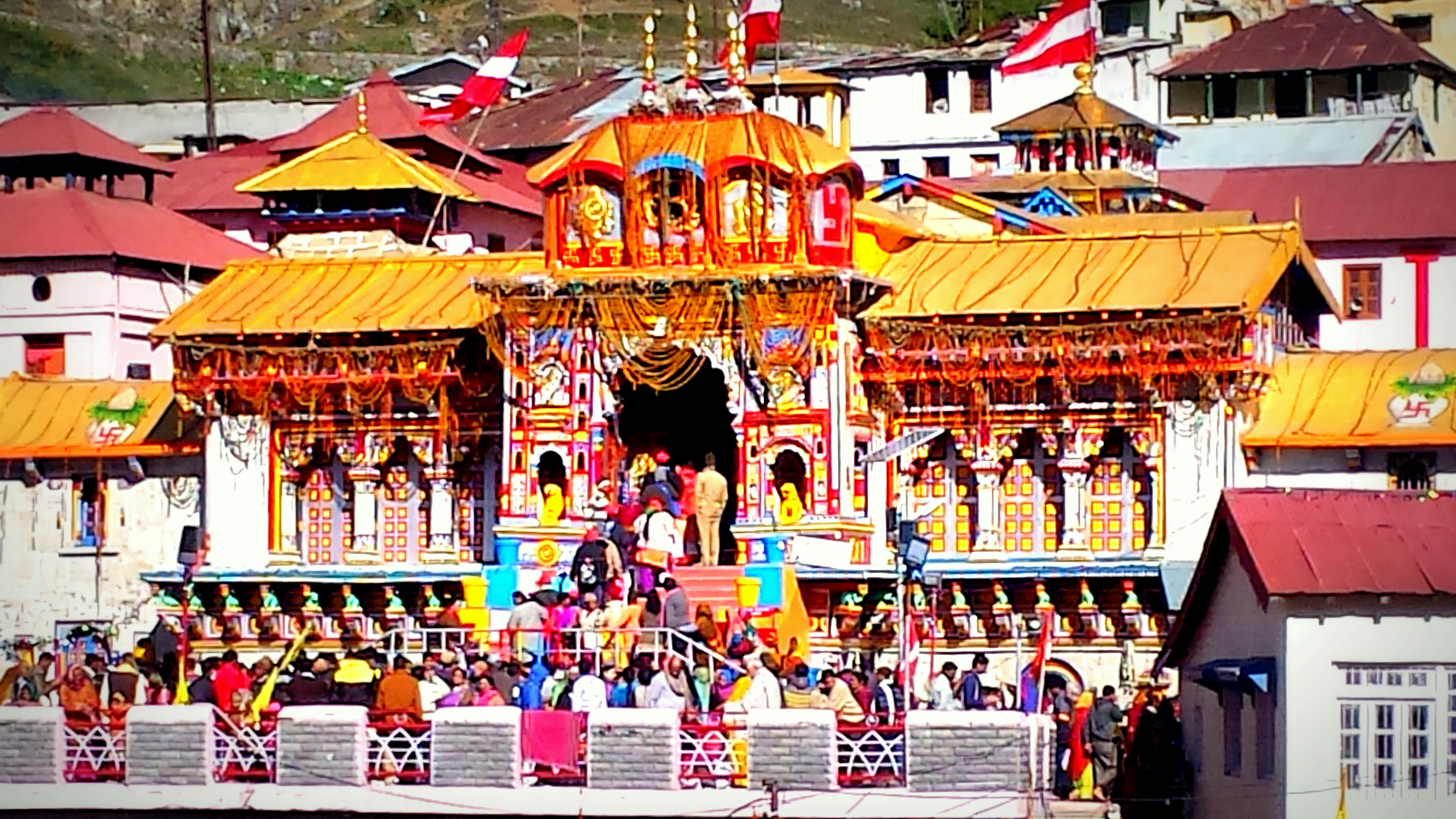
Badrinath dhaam is considered as one of the most sacred centres of pilgrimage situated in the lofty Himalayan heights in the Tehri-Garhwal hill tracks (Uttarakhand) at the height of 10,248 feet above sea level. Throughout the route to Badrinath there are numerous pilgrimage sites at Deva Prayag, Rudraprayag, Karana Prayag, Nanda Prayag, Vishnuprayag as well as Pandukeswar where the Pandavas are believed to have been born, and the site where Bhima and Hanuman (sons of Vayu) met. Lord MahaVishnu is believed to have done his penance in this place. Seeing the Lord doing his penance in the open, Goddess Mahalaxmi is believed to have assumed the form of Badri tree to provide him shelter to face the onslaught of the weather conditions, therefore the name Badri Narayan.
Roopkund
Roopkund is situated in the eastern part of Chamoli district (in the lap of Trishul Massif, 7122 m). The high-altitude (5029 m), kund is on the Nanda Jat route to Homkund. It is not a very large kund and is rather shallow, having a depth of only about 2 m. The edges are snow covered for most parts of the year. When snow melts, one can see human and equine skeletal remains, sometimes with flesh attached; well preserved in the alpine conditions.
|

|